
Artificial intelligence is compressing the timeline between vulnerability and exploitation. What used to take attackers weeks now takes hours, and in some cases, minutes. That shift affects every industry, but not in the same way.
Public sector organizations, healthcare providers, financial institutions, energy companies, and retailers all operate under different pressures. These sectors play a vital role in Canada's economy and communities, and they're also where Compugen works closely with organizations navigating increasingly complex enterprise IT environments. The common challenge is understanding whether their enterprise IT environment can respond at the speed today's threats demand.
Growing enterprise IT environments, expanding cloud platforms, aging infrastructure, and thousands of connected endpoints have made technology harder to govern than ever before. AI didn't create that complexity, but it has made it much harder to ignore.
Enterprise IT leaders are responsible for securing increasingly complex environments and are expected to answer for them. They need confidence that they understand where risk exists, how quickly it can spread, and whether their organization can respond before disruption turns into business impact.
The good news is that while every industry faces unique risks, the path to greater resilience starts with the same foundation: understanding your technology estate, strengthening governance, and building the operational discipline to respond with confidence.
Here’s a quick look at the challenges facing each specific industry.
Public Sector: Governing Enterprise IT at the Speed of Change
Public sector organizations face growing cyber risk because complex technology estates, purchasing cycles, resource constraints, and expanding third-party relationships make it harder to respond as threats accelerate.
Government organizations have never had the luxury of making technology decisions in isolation. Every investment must consider and balance budgets, procurement rules, compliance requirements, and the responsibility of protecting the information of its citizens.
Years of modernization have created increasingly complex enterprise IT environments. Critical services often depend on a mix of legacy infrastructure, cloud platforms, third-party partners, and shared technology. Each connection creates opportunities to improve service delivery, but it also increases the need for clear governance and visibility.
Recent cyber incidents affecting Canadian municipalities and government organizations, like the City of Hamilton ransomware attack in March 2024 and the RCMP supply chain attack in February 2025, have shown how quickly operational disruptions can affect public services and erode public confidence.
The objective is to understand where the greatest risks exist, make informed decisions faster, and build a secure and resilient enterprise IT environment that supports reliable public services even when conditions change.
Healthcare: Keeping Care Running While Cyber Risk Accelerates
Healthcare organizations face unique cyber risks because every connected system ultimately supports patient care.
Clinical applications, medical devices, and connected care environments have improved outcomes for patients while creating more complex enterprise IT environments behind the scenes. Security decisions must protect those systems without creating barriers for the clinicians who rely on them every day.
Canadian healthcare organizations have experienced ransomware attacks that disrupted operations and forced care teams to work around unavailable systems. Remember the LifeLabs ransomware attack of October 2019 or the SickKids Hospital LockBit ransomware attack in December 2022? Those incidents reinforced an important lesson: protecting healthcare is as much about maintaining continuity when disruption occurs than it is about preventing attacks.
Organizations making the greatest progress understand their security estate, know how critical systems depend on one another, and have tested strategies in place that allow them to recover quickly. That foundation supports stronger cybersecurity while helping clinicians stay focused on delivering care.
Finance: Protecting Trust in a Faster Threat Environment
Financial institutions are facing more sophisticated cyber threats than ever because AI is making fraud, phishing, and identity-based attacks easier to create and harder to detect.
The technology changes but the objective of cybercriminals remains the same: find the fastest path to customer information, financial assets, and public trust.
Canadian organizations have already experienced how security incidents can affect customer confidence long after systems have been restored. There was the 26-month long Desjardins Group insider breach from 2017–2019, as well as the Canada Revenue Agency credential stuffing of 2020.
That makes cybersecurity part of a much broader enterprise conversation. Leaders need confidence that their technology foundation can support innovation, meet regulatory expectations, and protect customer trust at the same time. AI is accelerating cyber risk, but it's also revealing whether enterprise IT is prepared to support the organization's next stage of growth.
Energy + Utilities: Securing Critical Infrastructure Without Slowing Operations
Energy and utility providers manage cyber risk while delivering services that communities depend on every day. Unlike many industries, they operate environments where business systems and operational technology work side by side. Many critical assets remain in service for years because updating them isn't always practical or even possible.
That reality makes lifecycle planning and governance just as important as technical controls.
AI has shortened the time between identifying a vulnerability and someone attempting to exploit it. At the same time, utilities can't simply pause essential services every time a new threat emerges to ramp up patching or catch up with the latest Zero Trust initiatives.
Recent cyber incidents, like the Nova Scotia Power ransomware attack in March 2025, demonstrate why operational resilience has become just as important as prevention.
Understanding the technology estate, knowing where critical assets may be exposed, and managing them throughout their lifecycle helps organizations respond more confidently while maintaining the services Canadians depend on.
Retail: Reducing Complexity Across Connected Operations
Retail organizations depend on highly connected enterprise IT environments to deliver the customer experiences people expect.
Stores, distribution centres, cloud platforms, payment systems, inventory applications, and supply chains all rely on technology working together. As those connections grow, so does the complexity of managing them.
When one part of the technology estate is disrupted, the effects extend well beyond IT. Sales are interrupted, employees lose productivity, customers become frustrated or nervous about sharing payment credentials, and brand reputation can suffer long after systems are restored.
Recent attacks against Canadian retailers, like the London Drugs ransomware attack of 2024 and the LCBO data breach of 2023, have shown how quickly those consequences can unfold.
Organizations that understand their technology estate, build in a solid security foundation based on Zero Trust, reduce unnecessary complexity, and maintain visibility and strong recovery capabilities across critical business systems are far better positioned to continue serving customers when disruption occurs.
Questions Every Enterprise IT Leader Should Be Asking
The questions every IT leader should be asking are becoming remarkably similar, regardless of whether you're delivering public services, supporting patient care, protecting financial transactions, operating critical infrastructure, or serving customers.
How well do you understand your technology estate? Can you quickly identify where cyber risk is increasing? Does your operational model support a significantly increased patching regimen? Have you achieved a Zero Trust environment? Have you tested whether your organization is able to recover quickly when disruption occurs?
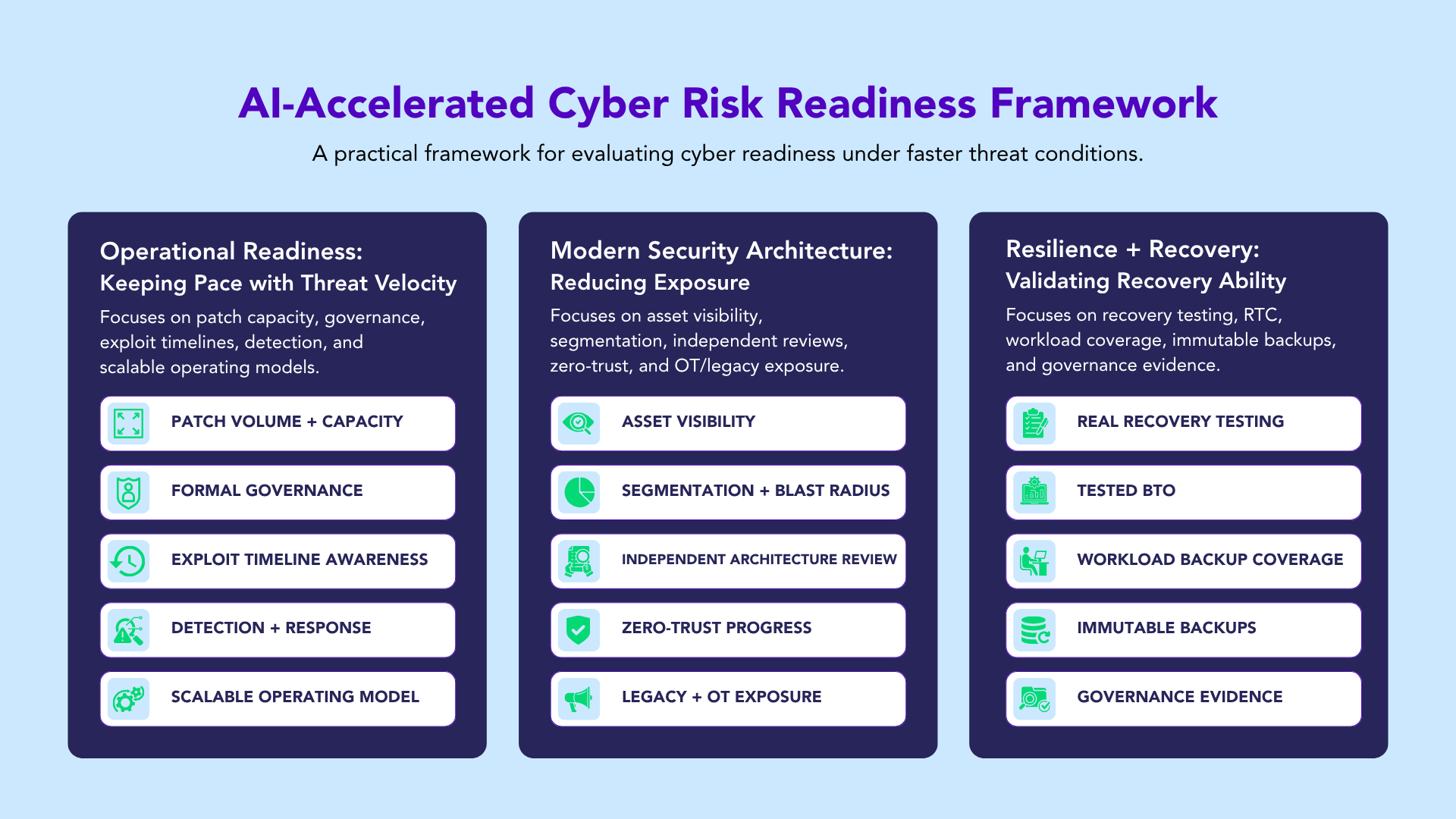
These aren't simply cybersecurity questions. They're enterprise IT questions. The organizations best prepared for the future will be the ones that can answer them with confidence.
Building a Stronger Enterprise IT Foundation
Every industry has its own priorities, regulations, and operational realities. What connects them is the growing complexity of the enterprise IT environments they depend on. And AI is exposing that complexity.
Organizations that understand their technology estate, strengthen security, and build operational flexibility, resilience and tested recovery capabilities into the way they operate will be better prepared for whatever comes next, whether that's adopting AI, meeting new regulatory expectations, or responding to the next cyber threat.
Cyber resilience isn't measured by how many security tools an organization owns. It's measured by how confidently it can keep the business moving when conditions change.
Understanding how AI is impacting cyber risk starts with understanding where you stand. Get in touch with us today for a complimentary working session with Compugen experts. We'll evaluate your organization's readiness for AI-accelerated cyber risk, and identify practical next steps for strengthening your operational readiness, security infrastructure and resilience.




.png)